Insight
AI Transformation Starts When Monday Changes
Training users is not AI transformation. Real change is when Monday’s work routes differently: connected workflows, rules in software, people where decisions matter.
- 1Adoption drivesTeach a new tool; the work still follows the old route.
- 2Architecture before usageRedesign workflows end-to-end; rules and data carry the work.
- 3One-off automationsScripts or bots without ownership, testing, or observability.
- 4Connected operationsWorkOS/DSS: linked steps, audit trails, humans decide where it counts.
The promise of AI transformation is not that your people learn a new button. It is that the work on Monday no longer depends on the old path.
tl;dr
- Adoption is not the outcome. Monday changing is.
- Architect the workflow first; tools follow the design.
- Put rules in software and people at the decision points.
- Build a WorkOS/DSS backbone, not one-off automations.
Monday, 09:00 — how work really moves
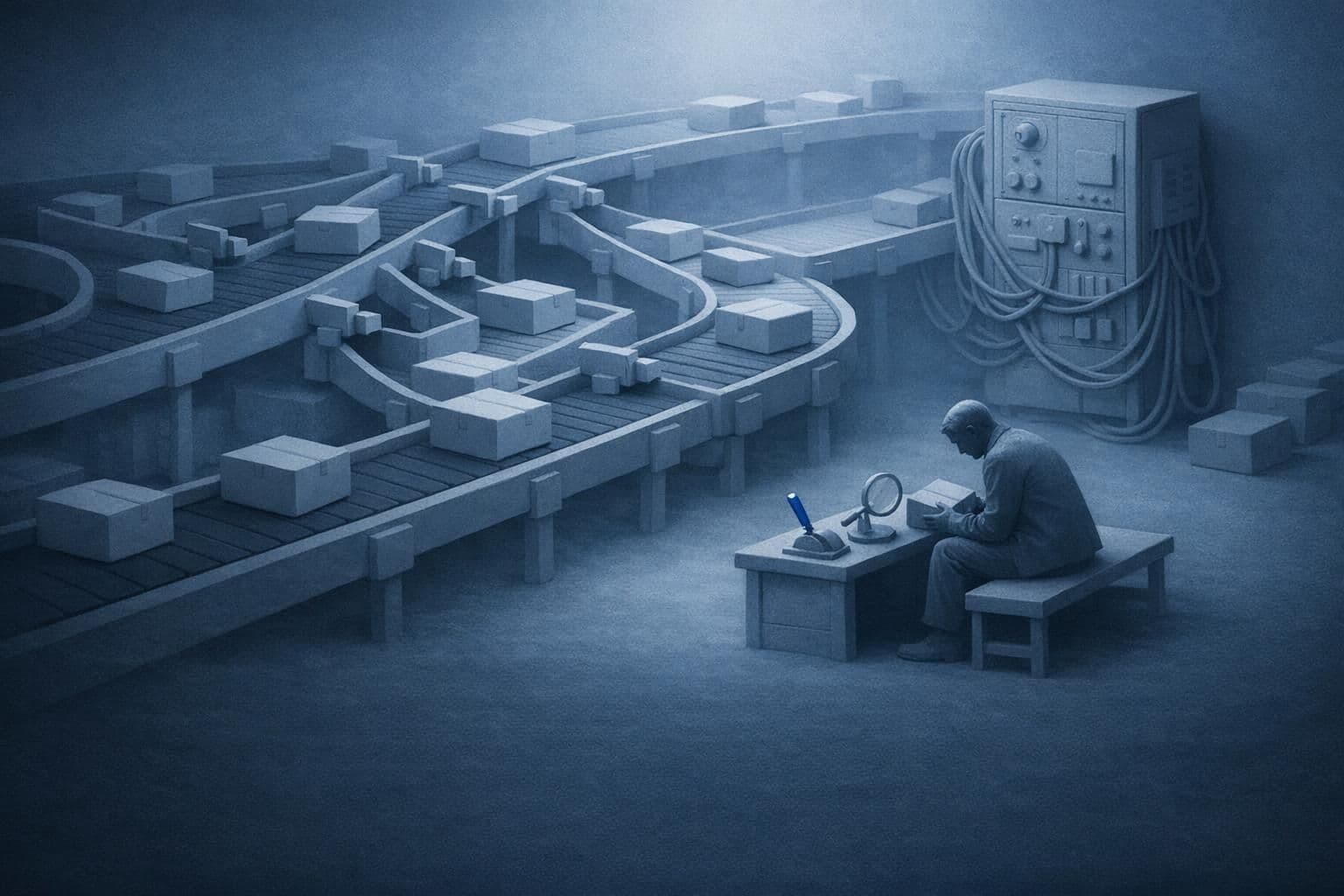
The day starts. Sales sends PDFs to operations. Operations copy lines into the ERP. Finance awaits a spreadsheet to approve. Planning walks a whiteboard. Someone checks a shared inbox for customer updates. A new AI tool is somewhere on the desktop, trained last month. The team means well, but the old route still runs the show.
Nothing changed in the path of work. Tasks still queue in emails, spreadsheets and chats. People carry context in their heads. Exceptions are invisible until they hurt a deadline. The shiny tool did not rewire the flow.
What AI transformation actually looks like
AI transformation lands when the path changes. The unit of change is the workflow, not the user. Orders, cases, bookings or claims move on new rails:
- A shared backbone tracks each work item and its state. Not in a person’s inbox — in the system.
- Clear rules handle the routine. Human review is a step, not an interruption.
- Data enters once, is checked once, and is reused everywhere.
- Exceptions are explicit. They route to roles with context, not to a mailbox.
- Every step is logged. You can answer: where is it, who owns it, what blocks it.
Models help where language, classification or prediction reduce toil. But the result is the same: Monday follows a new route that is faster, clearer and safer — with people where a decision still matters.
What really changes under the hood
Here is the shift we design for:
- From tools to systems: Tools support tasks. Systems govern flow. We build the system.
- From individuals to roles: Ownership lives in roles and queues, not in a name on a thread.
- From manual checks to rules in software: Validation, enrichment and routing are codified.
- From invisible work to telemetry: Timers, SLAs, audit trails and event logs are first-class.
- From brittle integrations to contracts: Canonical objects, versioned APIs, and tests.
We call the backbone WorkOS: connected operations across teams and tools. Where decisions matter, we add DSS patterns: decision support and guardrails around the judgment call.
Do this instead: architecture before apps
If you are serious about change, start with the map of work:
-
Name the core flows. Order-to-cash, procure-to-pay, case-to-resolution. Choose one.
-
Define the work item. Fields, states, transitions. What closes it? What blocks it?
-
Codify the rules. Validation, routing, service levels, and compliance checks.
-
Place the humans. Which steps require judgment? What evidence do they need?
-
Connect the tools. ERP, CRM, WMS, email, files. Decide the source of truth for each field.
-
Design the controls. Auditability, approvals, change management, and rollback plans.
-
Then choose the tech. Sometimes it’s simple rules. Sometimes an LLM to read a document. Sometimes an agent to triage a queue. Always inside the backbone so work stays visible and owned.
This is systems integration with purpose. Custom software where it pays off. AI where it removes friction. People in the loop where the outcome matters.
Why a generic tool or a one-off flow won’t hold
- Adoption first thinking: You get training sessions and dashboards of “active users”. Meanwhile, lead time, error rate and rework do not move. Because the old path did not change.
- Islands of automation: A script renames files. A bot posts in chat. Useful, until the next exception breaks it. No owner, no tests, no telemetry, no fallback.
- App sprawl as policy: Adding yet another app hoping it will self-organise the work. It won’t. Without a backbone, each app becomes another inbox.
- Model-maximalism: Forcing an LLM where a rule fits better. The right answer is often both: rules for the clear part, a model for the fuzzy part — under one roof.
The wrong buy feels busy. The right build makes Mondays quiet.
How we work at Agimatic
- Opportunity audit: We walk your flows, find where work stalls, and identify the few rules or models that unlock movement.
- Process architecture: We design the WorkOS/DSS backbone — objects, states, rules, roles, and events — mapped to your workflows.
- Production deployment: We connect to the tools you already use. We ship the backbone, interfaces for people-in-the-loop, and the necessary models.
- Ongoing optimisation: We watch the telemetry. We improve rules, retrain where needed, and help your team own the system safely.
You keep control. Human approvals where risk lives. Clear logs for finance, operations and compliance. No theatre. Just better flow.
The next step
If you want Monday to change, not just the slide deck, talk to Agimatic. We’ll map one core workflow, show the backbone it needs, and scope a path to production.
Book a conversation. Let’s design the system around your work — and make AI part of how your business runs.
Next step
What could AI transformation do for your business?
We map your workflows and show where AI, automation and software can make a concrete difference.